

July 7, 2025
In the ever-changing aviation industry, staying ahead requires embracing innovation. With over 9,000 flights crossing 18 million square kilometers of Canadian airspace daily, ensuring safe and efficient air traffic management is a significant challenge. It calls for collaboration, flexibility, and cutting-edge technology.
At NAV CANADA, we’ve taken a bold step forward by exploring and implementing Digital Twin technology, a move that’s transforming how we plan and manage airspace operations.
Five years ago, NAV CANADA began investigating the potential of Digital Twin technology. By 2020, we launched a proof of concept, and since then, we’ve developed a powerful use case to enhance daily capacity planning.
The result is the Digital Twin–Sector Performance Optimizer (DT-SPO), now operational at cruising altitudes across all Area Control Centres (ACCs) in Canada. This AI-powered tool provides predictive insights that help our operational teams plan more effectively as they take into account the everyday tactical events.
.png)
A Digital Twin is a virtual model of real-world operations created using historical data. Our DT-SPO tool simulates scenarios and offers recommendations to support daily decision-making, up to 30 hours in advance.
“This AI-enabled tool supports daily strategic decision-making at ACCs across the country, enhancing operational efficiency and building resilience to everyday challenges."— Stephanie Castonguay, Assistant Vice President, IFR Services
DT-SPO integrates historical operational data into NAV CANADA’s cloud platform. From there, it can:
Using advanced analytics and a proprietary algorithm, DT-SPO combines airspace and flight data with employee scheduling to forecast sector configurations. Business rules from operational experts guide these forecasts and include recommendations for opening or closing sectors to optimize coverage and service delivery.
“The task load measurement is new for us and provides a better picture not just based on traffic volume, but also the complexity of tasks we will be faced with. " — Peter Hamm, Operations Duty Manager, Winnipeg
See DT-SPO in action below, showing how the tool recommends sector configurations and staffing levels throughout the day.
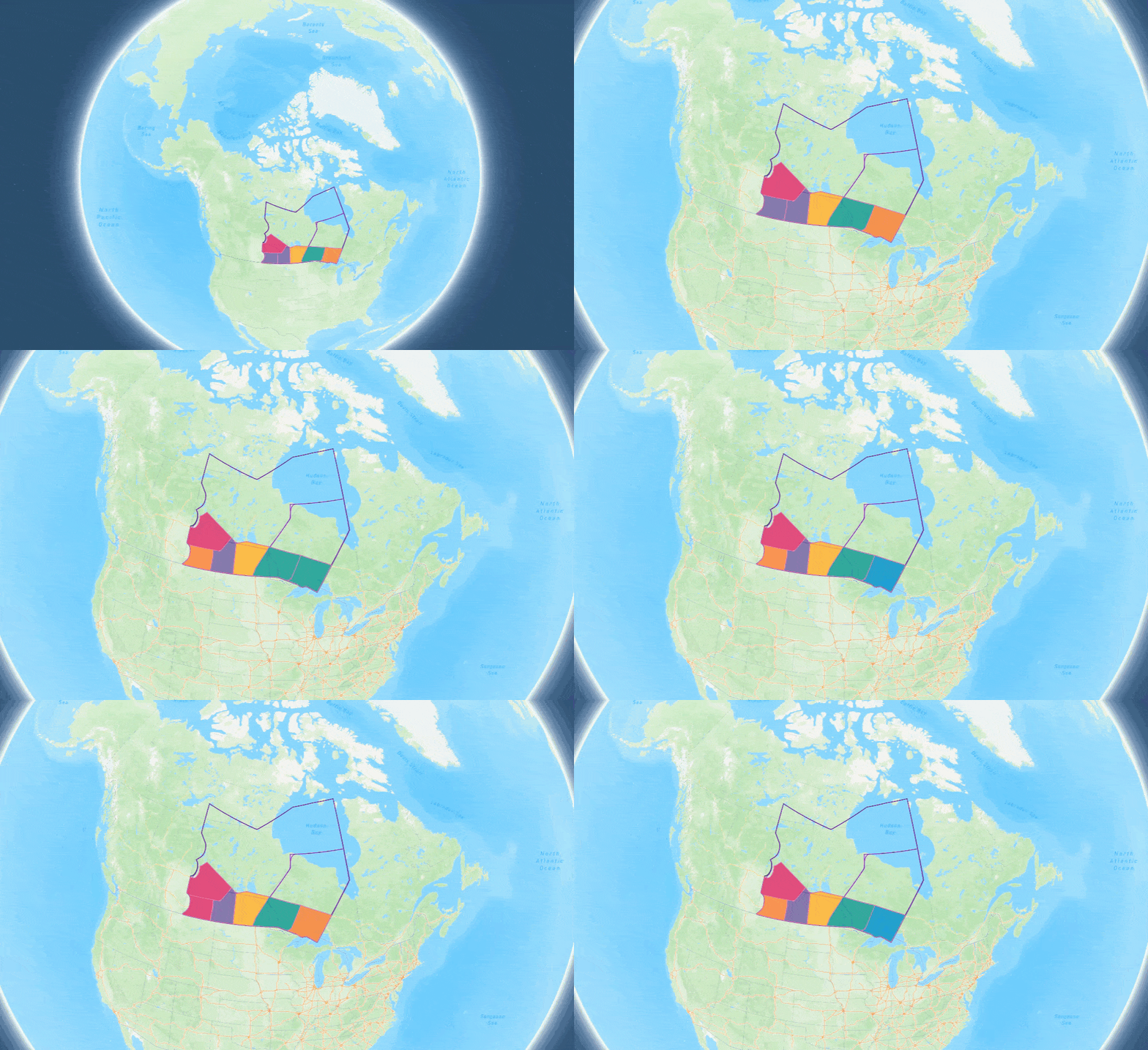
This animation shows Canada’s airspace with the Winnipeg Flight Information Region (FIR) outlined in blue. The coloured blocks represent the partitioned airspace. Based on historical traffic patterns, our Digital Twin tool recommends how to divide the airspace and the necessary staff needed throughout the day to manage demand safely and efficiently.
The development and implementation of DT-SPO has been a deeply collaborative effort. Starting at the Toronto ACC, the tool was gradually rolled out to the ACCs in Winnipeg, Edmonton, Vancouver, Montreal, Moncton, and, most recently, Gander in June.
This success is a testament to the strong partnership between our Technology and Operations teams. And the journey doesn’t stop here. As an AI-powered system, DT-SPO continues to evolve, shaped by ongoing feedback from operational professionals across the country.
On May 13, NAV CANADA’s DT-SPO was named runner-up in the Air Traffic Management (ATM) AwardsOpen a new window for “Innovation to Enable Sustainable Future Skies.” This recognition celebrates organizations that are pushing the boundaries of technology, automation, and operations to shape the future of aviation.
We’re honoured to be recognized alongside global leaders in air traffic management and proud that our work is helping to enhance safety, efficiency, and sustainability in Canadian airspace.
After nearly five years of development, DT-SPO’s potential is just beginning to unfold. With its successful implementation in the cruising altitude airspace, the next phase will enhance the tool by incorporating weather factors into the predictions and expand its use to more regions across the country.
Encouraged by the positive impact so far, we’re excited to explore additional Digital Twin use cases that will further modernize our operations and elevate the service we provide to the travelling public.