

April 29, 2017
The first-ever flight test of the Aireon space-based ADS-B system was conducted in early March by a team from NAV CANADA flying one of our CRJ-200 flight inspection aircraft across Northern Canada.
The test was part of the rigorous testing and validation process of the ADS-B payloads aboard Iridium NEXT satellites in low-earth orbit. The first 10 satellites of the 66-satellite constellation were launched into space on January 14.
The flight test team’s first goal was to confirm that the payload was operating as designed. Second, it was tasked with measuring performance to determine how well the system could generate the kind of data required for air traffic control. In both instances, the results have been very encouraging.
Each payload was expected to “see” aircraft up to a distance of 2,800 kilometres away. Instead, the test results indicate a ‘slant range’ of 3,500 kilometres, exceeding the team’s expectations.
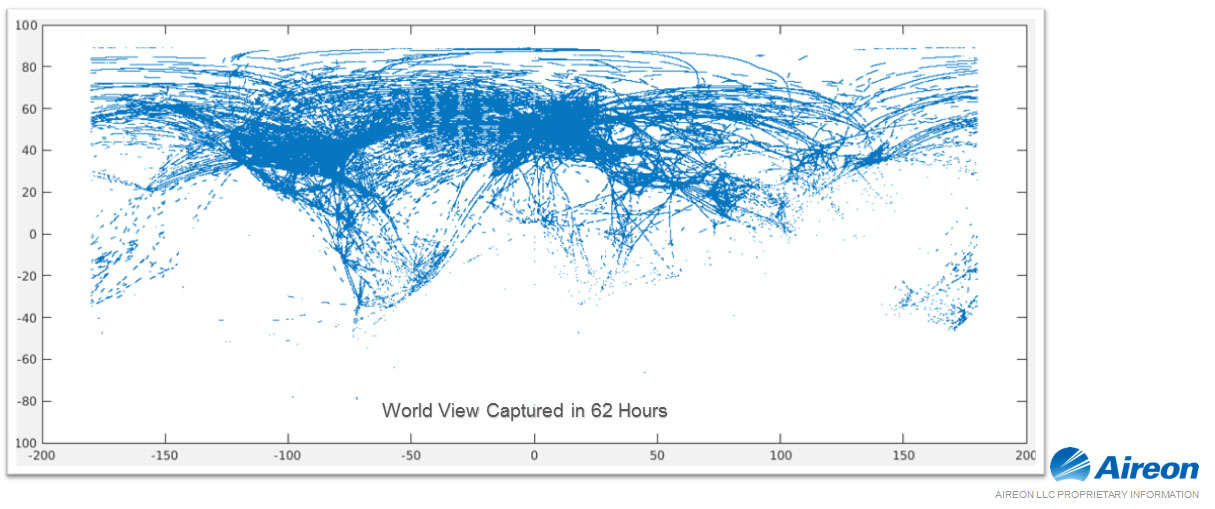
During the Initial Performance Verification, with 1 of 66 payloads, Aireon was able to decode positions for 17,229 unique aircraft in 62 hours (37 orbits).
This performance equates to a higher-than-anticipated degree of robustness and operability in meeting ATC capabilities, once Aireon goes operational in 2018.
Other tests with other ANSP customers will be flown to validate the data and to make sure it is consistent with the data that is generated on the ground.
A key requirement of the NAV CANADA flight was to test how the space-based ADS-B system performs when an aircraft uses the lowest transponder power permitted under current standards. For the duration of the flight, NAV CANADA lowered its transponder power output to that minimum (125 watts).
The flight route consisted of three legs over two days:
The North was selected for two main reasons. At higher latitudes, the aircraft’s speed is not much slower than the earth’s rotational speed, so by flying westbound the aircraft could nearly stay under a satellite’s east-to-west orbit plane during successive passes. This maximized the number of data-collection opportunities.
Northern Canada also has relatively few interfering radio transmission sources, so this helped the flight test establish a baseline performance level in a lower-noise environment.